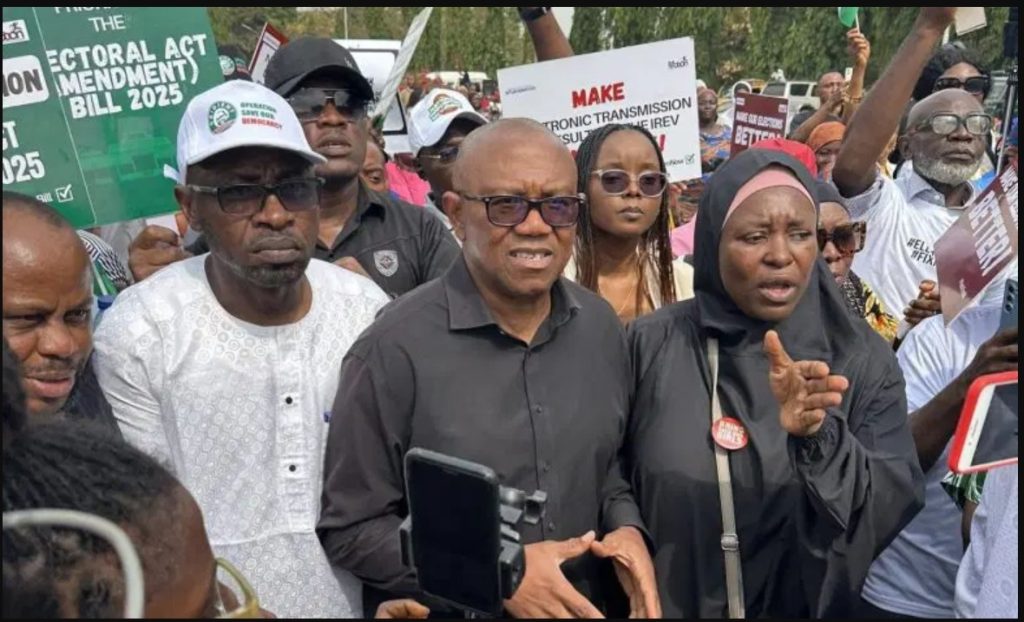
The National Assembly became the epicenter of a heated political standoff on Wednesday as hundreds of protesters, led by Labor Party’s 2023 presidential candidate Peter Obi, besieged the complex to demand the mandatory “real-time” electronic transmission of election results. The demonstration, tagged “Occupy the National Assembly,” was triggered by a controversial move by the Senate
The National Assembly became the epicenter of a heated political standoff on Wednesday as hundreds of protesters, led by Labor Party’s 2023 presidential candidate Peter Obi, besieged the complex to demand the mandatory “real-time” electronic transmission of election results.
The demonstration, tagged “Occupy the National Assembly,” was triggered by a controversial move by the Senate last week to omit the word “real-time” from the proposed amendments to the Electoral Act (2022) Repeal and Enactment Bill 2026.
Obi Leads the Charge for Transparency
Addressing the sea of young supporters and civil society activists, Peter Obi emphasized that technological transparency is non-negotiable for the 2027 general elections.
“Simple transmission of results is not a difficult thing. We must allow the elections to go through a transparent process so that the true will of the Nigerian people is reflected. Whoever wins, we will accept, but the process must be clear,” Obi stated amidst cheers from the crowd.
The protesters, including members of the “Obedient Movement” and the Nigeria Civil Society Situation Room, argued that removing the “real-time” requirement creates a dangerous loophole for manual manipulation during the collation process.
A Divided Parliament
The clash highlights a significant rift between the two chambers of the National Assembly:
- The House of Representatives: Has largely supported the provision for mandatory electronic transmission to the INEC Result Viewing Portal (IReV).
- The Senate: Initially resisted the clause. Senate President Godswill Akpabio and other ranking members had cited concerns over poor internet penetration in rural areas as a reason to keep the transmission “permissible” rather than “mandatory.”
However, following a 48-hour wave of national outcry and threats of a nationwide strike by the Nigeria Labour Congress (NLC), the Senate reportedly signaled a retreat during an emergency session on Tuesday.
What’s at Stake?
The 2023 elections were marred by “technical glitches” that prevented the real-time upload of presidential results, a failure that became the bedrock of numerous legal challenges. By enshrining “real-time” transmission into law, reformists aim to:
- Eliminate Human Interference: Reducing the window where result sheets can be “altered” between polling units and collation centers.
- Boost Public Confidence: Restoring faith in the Independent National Electoral Commission (INEC).
- Legal Backing: Giving the IReV portal full legal weight in election tribunals.
Next Steps
To resolve the impasse, a Joint Harmonization Committee of both the Senate and the House of Representatives is expected to meet within the next 48 hours to align their versions of the Bill before transmitting it to President Bola Tinubu for assent.
















Leave a Comment
Your email address will not be published. Required fields are marked with *