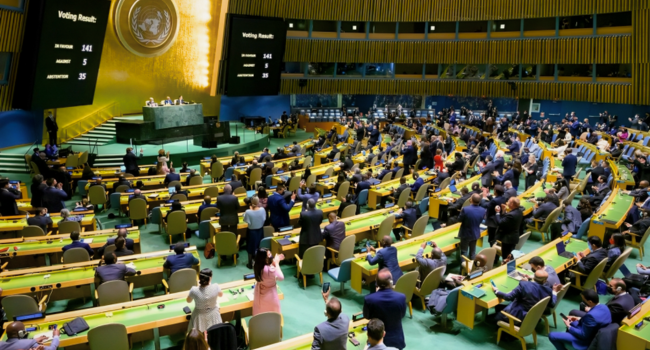
The United Nations General Assembly is set to vote on a landmark resolution seeking to officially recognise the transatlantic slave trade as “the gravest crime against humanity,” a move supporters say is crucial for justice and historical accountability. The initiative has been strongly backed by John Dramani Mahama, who described the proposal as a significant
The United Nations General Assembly is set to vote on a landmark resolution seeking to officially recognise the transatlantic slave trade as “the gravest crime against humanity,” a move supporters say is crucial for justice and historical accountability.
The initiative has been strongly backed by John Dramani Mahama, who described the proposal as a significant step toward acknowledging the suffering of millions of Africans affected over centuries.
Speaking at the UN, Mahama noted that more than 12.5 million Africans were forcibly taken from their homes over a period of about 400 years, stressing the need for the global community to fully recognise the scale and impact of the tragedy.
The proposed resolution not only acknowledges the historical injustice but also calls for restorative measures. It urges countries linked to the slave trade to engage in processes such as formal apologies, the return of looted cultural artifacts, and efforts to address the lasting effects of racial inequality.
According to Samuel Okudzeto Ablakwa, nations involved in the slave trade—including European countries and the United States—should take responsibility through meaningful reparative actions.
The resolution also highlights the enduring legacy of slavery, pointing to ongoing issues such as racial discrimination and structural inequalities that persist in many parts of the world.
While some critics have raised concerns that the classification could create a hierarchy of historical suffering, proponents insist that the intention is not to compare tragedies but to accurately describe the scale and lasting impact of the transatlantic slave trade.
If adopted, the resolution would mark a major step in global recognition of one of history’s most devastating systems of exploitation, while opening broader discussions on justice and reparations.












Leave a Comment
Your email address will not be published. Required fields are marked with *