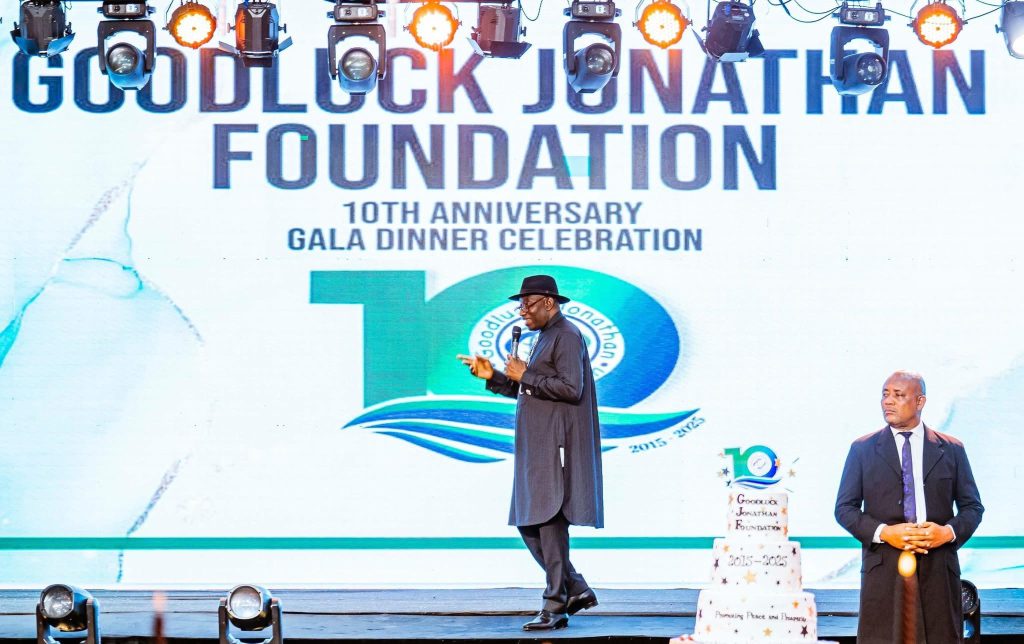
Former President Goodluck Jonathan has questioned the ability of democracy in Africa to consistently deliver economic growth, drawing comparisons with countries like China and United Arab Emirates where significant economic progress has been recorded outside democratic systems. He made the remarks at the 10th anniversary of the Goodluck Jonathan Foundation during the launch of a
Former President Goodluck Jonathan has questioned the ability of democracy in Africa to consistently deliver economic growth, drawing comparisons with countries like China and United Arab Emirates where significant economic progress has been recorded outside democratic systems.
He made the remarks at the 10th anniversary of the Goodluck Jonathan Foundation during the launch of a report focused on strengthening the link between democracy and economic development in Nigeria.
Jonathan noted that democracy globally is facing increasing pressure from economic hardship, insecurity, social tensions, and declining public trust in institutions. In Africa, he said, these challenges are reflected in disputed elections, democratic setbacks, and rising instability.
According to him, while democracy is often assumed to drive economic growth, that relationship has not been thoroughly examined within the African context. He stressed the need to rethink how democratic governance can better support economic transformation and shared prosperity.
He explained that democracy should go beyond elections, describing it as a system built on accountability, inclusion, and strong institutions that can create opportunities for innovation, enterprise, and sustainable development.
Jonathan, however, warned that when democratic systems fail to deliver economic progress, they risk losing credibility. He emphasized that Nigeria must focus on implementing effective economic policies to strengthen the sustainability of its democratic system.
Reflecting on global comparisons, he questioned why some non-democratic countries continue to achieve strong governance outcomes and economic success, even attracting citizens from democratic nations seeking better opportunities.
He called on policymakers, civil society, and the private sector to take the report’s findings seriously, urging collective action to ensure democracy translates into real improvements in people’s lives through prosperity, opportunity, and justice.













Leave a Comment
Your email address will not be published. Required fields are marked with *