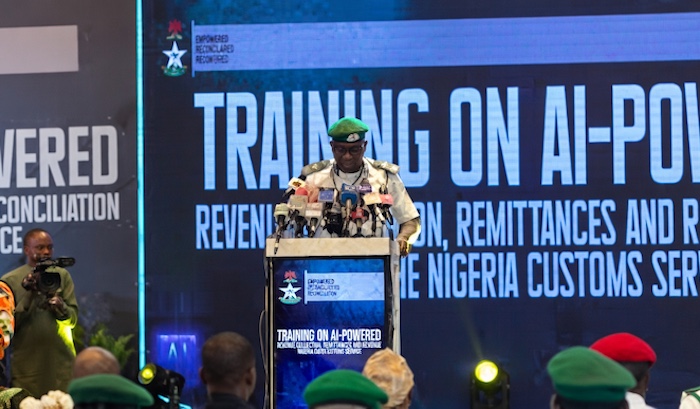
Comptroller-General of the Nigeria Customs Service (NCS), Mr. Adewale Adeniyi, on Monday flagged off a capacity-building programme for the adoption of Artificial Intelligence (AI) to boost customs revenue operations, curb leakages, and enhance transparency and accountability. Adeniyi spoke in Abuja at the opening of a training on AI-driven revenue generation and remittances for the NCS.
Comptroller-General of the Nigeria Customs Service (NCS), Mr. Adewale Adeniyi, on Monday flagged off a capacity-building programme for the adoption of Artificial Intelligence (AI) to boost customs revenue operations, curb leakages, and enhance transparency and accountability.
Adeniyi spoke in Abuja at the opening of a training on AI-driven revenue generation and remittances for the NCS.
He said over the past decade, technology had played a significant role in improving the service’s operations, adding, “We now deploy risk management systems that help us assess and monitor activities more effectively.”
He said as part of ongoing reforms, the service was committed to transparency and accountability, stressing that the objective is to strengthen revenue generation while ensuring compliance with established standards.
Essentially, the service is seeking to enhance revenues without necessarily imposing extra burden on operators through the use of artificial intelligence which would help to plug leakages. The systems will be able to flag under-declared cargoes.
Adeniyi stated, “More recently, we have begun integrating Artificial Intelligence into our processes. AI-enabled cameras and systems now help us detect patterns, monitor movements, and identify anomalies. These tools enhance our ability to prevent irregularities and improve decision-making.
“We are encouraged by the potential of AI to transform our operations further. Its application in data analysis, risk assessment, and operational efficiency is significant.
”He added that although the service is still in the early stages, there is a need to build more capacity and deepen understanding of these technologies, noting that multiple stakeholders are involved and collaboration remains essential.
Adeniyi further said, “These systems enable us to identify areas of concern and respond appropriately. We have also introduced platforms that support post-clearance audits and enhance collaboration with other stakeholders, including international partners.
“In addition, we have adopted modern systems that allow for better data processing and analysis. These innovations have improved efficiency and strengthened our capacity to manage operations across the board.
”He added that the service would continue to expand its capabilities and leverage AI more effectively, urging other institutions to adopt similar measures for collective benefit.
According to him, the initiative is part of a broader effort to build a more efficient and responsive system, with continued investment in training and capacity development to ensure personnel are well-equipped for a data-driven environment.
In her remarks, Customs Deputy Comptroller-General, Finance, Administration and Technical Services, Kikelomo Adeola, said, “This is not just about rhetoric; it is about creating a platform for transformation. When we speak about change, it must be meaningful and impactful.
“We must also appreciate the efforts of those who have continued to drive this initiative forward, despite challenges.
“The commitment to building capacity within our systems is highly commendable. However, there is still much work to be done.
”She added that in today’s complex financial environment, stronger systems are needed to support accurate revenue processes and improve institutional coordination.

















Leave a Comment
Your email address will not be published. Required fields are marked with *