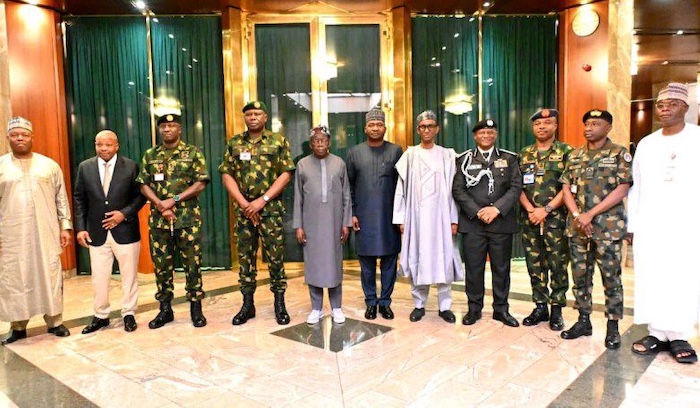
President Bola Ahmed Tinubu on Monday afternoon met with the three service chiefs, the Chief of Defence Staff (CDS), the Inspector-General of Police, and heads of intelligence agencies at the State House, Abuja. The emergency meeting was convened amid mounting concerns over the country’s security situation, especially recent attacks on military formations in Borno State.
President Bola Ahmed Tinubu on Monday afternoon met with the three service chiefs, the Chief of Defence Staff (CDS), the Inspector-General of Police, and heads of intelligence agencies at the State House, Abuja.
The emergency meeting was convened amid mounting concerns over the country’s security situation, especially recent attacks on military formations in Borno State.
The closed-door session was attended by Chief of Defence Staff, General Olufemi Oluyede; Chief of Army, Lt. Gen Waidi Shaibu; Chief of Naval Staff, Vice Admiral Idi Abbas; and Chief of Air Staff, Air Marshal Sunday Anele.
Also in attendance were the Director-General of the Department of State Services (DSS), Oluwatosin Ajayi; Director-General of the National Intelligence Agency (NIA), Ambassador Mohammed Mohammed; and the Inspector-General of Police, Tunji Disu.
National Security Adviser to the President, Mallam Nuhu Ribadu, was also present alongside other top security officials.
The security meeting followed a controversial Nigerian Air Force airstrike in Borno State that reportedly killed over 100 civilians.
The strike occurred on Saturday at Jilli Market along the Borno–Yobe border and was aimed at suspected Boko Haram targets.
While the Nigerian Air Force confirmed carrying out “precision mop-up airstrikes on identified terrorist locations” in the Jilli axis, it did not acknowledge civilian casualties or confirm that a market was hit.
Defending the operation, the presidency stated that the location had been compromised by insurgents.
Senior Special Assistant to the President on Media and Publicity, Tope Ajayi, said the market had become “a legitimate military target” after being turned into a logistics and trading hub by Boko Haram and ISWAP fighters.
The meeting came against the backdrop of recent developments, including a travel advisory issued by the United States Department of State, authorising the voluntary departure of non-emergency government personnel and their families from its embassy in Abuja.
The advisory, issued on April 8, cited a “deteriorating security situation” and placed 23 of Nigeria’s 36 states under a “Level 4: Do Not Travel” classification, the highest risk category.
States later added to the advisory included Plateau, Jigawa, Kwara, Niger and Taraba.
The US authorities highlighted threats ranging from insurgency in the North-east to banditry in the North-west and North-central, as well as persistent violence in parts of the South and South-east, including the oil-producing regions.
The embassy subsequently suspended visa appointments in Abuja, although its Lagos consulate continued to offer routine and emergency services.
Reacting to the advisory, the federal government described it as a routine precaution based on US internal protocols, insisting it did not reflect the broader security reality across the country.
Minister of Information and National Orientation, Mohammed Idris, said while isolated incidents persist, “there is no general breakdown of law and order, and the vast majority of the country remains stable.
”Former Chief of Army Staff, Lieutenant General Tukur Buratai (rtd), described the Jilli Market airstrike as a necessary blow to a terrorist hub in the North-east operational theatre.
He commended the Nigerian Air Force and intelligence community for their professionalism, stating that the strike was based on credible intelligence showing Boko Haram and ISWAP were using the market for logistics and planning attacks.
Buratai said the area had long served as a terrorist logistics hub and warned that civilian casualties, while regrettable, resulted from terrorists embedding themselves within civilian spaces.
Former Senate President Ahmad Lawan called for an immediate and independent investigation into the airstrike, expressing concern over the scale of civilian casualties and urging transparency and compensation for victims.
Kaduna State Governor, Senator Uba Sani, warned against the politicisation of insecurity, stressing that his administration would deal decisively with any attempts to undermine peace in the state.







Leave a Comment
Your email address will not be published. Required fields are marked with *