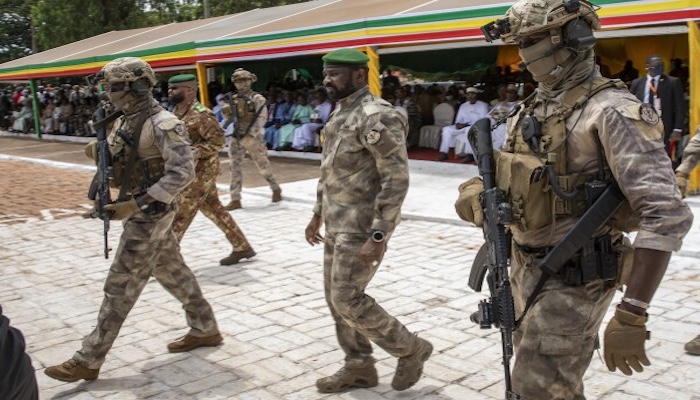
Mali’s Defence Minister, Sadio Camara, has reportedly been killed at his residence near the main army base in Kati, just outside the capital Bamako, according to France’s RFI radio and two relatives. The attack, which occurred on Saturday, formed part of a broader and highly coordinated offensive carried out by an al-Qaeda-linked group, Jama’at Nusrat
Mali’s Defence Minister, Sadio Camara, has reportedly been killed at his residence near the main army base in Kati, just outside the capital Bamako, according to France’s RFI radio and two relatives.
The attack, which occurred on Saturday, formed part of a broader and highly coordinated offensive carried out by an al-Qaeda-linked group, Jama’at Nusrat al-Islam wal-Muslimin (JNIM), alongside a Tuareg-dominated rebel faction. Analysts and diplomats described the operation as one of the most significant assaults in Mali in recent years.
The United Nations expressed concern over the escalating violence across the Sahel region.“The Secretary-General is deeply concerned by reports of attacks in several locations across Mali. He strongly condemns these acts of violence,” a UN spokesperson said in a post on X.
If confirmed, Camara’s death would deal a major blow to Mali’s ruling military leadership. Djenabou Cisse, an associate fellow at the Foundation for Strategic Research (FRS), said the development could carry wide implications.“As a key figure within the junta and a central architect of the Mali–Russia rapprochement, his removal would underscore JNIM’s capacity to strike at the core of state power,” she said.
Camara has been a central figure in Mali’s military government under Colonel Assimi Goita, which came to power following coups in 2020 and 2021. He played a major role in pivoting the country’s alliances toward Russia while reducing ties with Western military partners.
Saturday’s offensive extended beyond Kati, with additional attacks reported near Bamako airport and in northern and central areas including Mopti, Sevare and Gao. The situation in Kidal, a strategically important northern city, remained unclear on Sunday.
The Azawad Liberation Front (FLA), a Tuareg-led group aligned with JNIM, claimed it had taken control of Kidal. A spokesperson said on X that an agreement allowed Russian mercenaries to withdraw from a besieged camp outside the city, where Malian forces had been stationed.
However, Mali’s armed forces disputed the claim, stating that operations were ongoing to repel insurgents in Kidal and other areas.
Ulf Laessing, head of the Sahel programme at Germany’s Konrad Adenauer Foundation, described the development as a setback for Russia, which has supported Mali’s military government since the expulsion of Western forces.“For Russia the attack has been a disaster,” Laessing said. “They were unable to prevent the fall of the highly symbolic Tuareg stronghold of Kidal and now need to leave this northern city.”
Russian state media offered a different account, with broadcaster Vesti reporting that Moscow’s Africa Corps, alongside Mali’s Presidential Guard and armed forces, was actively resisting the offensive and had prevented militants from seizing the presidential palace. It added that some members of the Africa Corps were wounded but gave no further details.
The latest violence highlights growing concerns about Mali’s security situation despite assurances from the military-led government that stability would improve.
In September 2024, JNIM fighters attacked a gendarmerie training school near Bamako airport, killing about 70 people. More recently, the group has enforced a fuel blockade that has disrupted electricity and supply chains in the capital.
As developments continue, Mali’s government has attempted to balance its security partnerships, including renewed engagement with the United States. However, tensions remain high, with the country’s foreign minister accusing neighbouring states and foreign powers of supporting terrorist groups, though no nations were identified.
Investigations into Saturday’s attacks are ongoing, with the full extent of casualties and territorial losses yet to be confirmed.









Leave a Comment
Your email address will not be published. Required fields are marked with *