The federal government has revealed that revenue from Nigeria’s solid minerals sector rose to about ₦68.1 billion in 2025, with remittances into the Federation Account reaching ₦63.92 billion within the first eleven months of the year. The update was presented as stakeholders gathered in Abuja for the Africa Commodities Conference and Exhibition (ACCE), where proposals
The federal government has revealed that revenue from Nigeria’s solid minerals sector rose to about ₦68.1 billion in 2025, with remittances into the Federation Account reaching ₦63.92 billion within the first eleven months of the year.
The update was presented as stakeholders gathered in Abuja for the Africa Commodities Conference and Exhibition (ACCE), where proposals were also made to deepen local participation in the industry by expanding and empowering cooperatives.
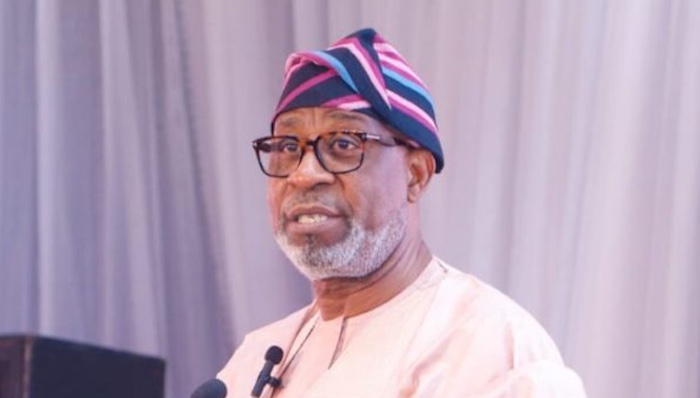
Delivering a paper at the conference—organised by Mica Equity Allocation Limited in partnership with IPW, the Federal Ministry of Solid Minerals Development, and the Solid Minerals Development Fund—Minister of Solid Minerals Development, Mr. Dele Alake, said ongoing reforms are beginning to produce tangible results.
According to him, total revenue for 2025 stood at ₦68.1 billion, while Federation Account remittances reached ₦63.92 billion in the first eleven months alone.
He further disclosed that royalties increased by ₦19.3 billion, representing a 110.1 percent rise, while revenue from the Mining Cadastre Office grew by ₦6.51 billion, or 107 percent, bringing it to ₦12.58 billion.
In addition, over 250 new cooperatives have been registered to integrate artisanal miners into the formal economy.
“Those are not yet the numbers of a mature mining giant, but they are the numbers of a sector that is gaining fiscal traction through reform, enforcement, and better administration,” he said.
Represented at the event by Mr. Etibo Umoakpan, the minister also highlighted broader sector growth, noting the entry of 142 new mining companies, a 93.27 percent rise in Private Mineral Buying Centre registrations from 223 to 431, and an increase of 513,600 tonnes in mineral output—equivalent to 343.8 percent growth over recent years.
On economic contribution, he stated that the sector now accounts for approximately 1.5 percent to 1.8 percent of Nigeria’s GDP, reflecting gradual but meaningful progress from previously negligible levels.
Despite these gains, Alake acknowledged ongoing challenges, including inadequate infrastructure in mining corridors, limited geological data confidence for investors, and the need for stricter enforcement of environmental and social governance standards.
“Environmental and social governance must be enforced more consistently. Community trust must be deepened through stronger implementation of Community Development Agreements.
“We have strengthened enforcement against illegal mining. We have expanded formalisation among artisanal operators. We have elevated value addition from a slogan to a licensing principle,” he said.
Stakeholders at the ACCE stressed the importance of increasing indigenous participation in the sector through training, capacity building, and access to essential equipment.
Conference convener, Michael Akueche, explained that the initiative focuses on empowering key professional groups, including geologists, mineral processing engineers, mining engineers, health and safety experts, and artisanal miners.
He also emphasised the need to grow cooperative membership to enable access to capital-intensive mining and processing equipment.
“What we’re trying to do is that, as part of the 7-Point agenda of the ministry of the solid mineral development and the Renewed Hope agenda of Mr. President, which is that the undocumented miners and illegal miners,
“Look at the length and breadth of our nation, there are still lots of illegal miners going on, and the government is saying, why don’t you set up a cooperative and operate in a regulated environment?
“And as a matter of fact, a number of people were able to set up cooperatives, but we discovered two challenges with them.
“Number one is that they have challenges with mining equipment, mineral processing equipment. We realize that it is difficult because the scope of their membership is very small, and these equipment are very costly, and had several meetings trying to explore for this solution,” he said.
Also speaking, Executive Secretary of the Solid Minerals Development Fund (SMDF), Hajiya Fatima Umaru Shinkafi, noted that the agency was created to help local operators in the sector access funding needed to expand their operations.











Leave a Comment
Your email address will not be published. Required fields are marked with *