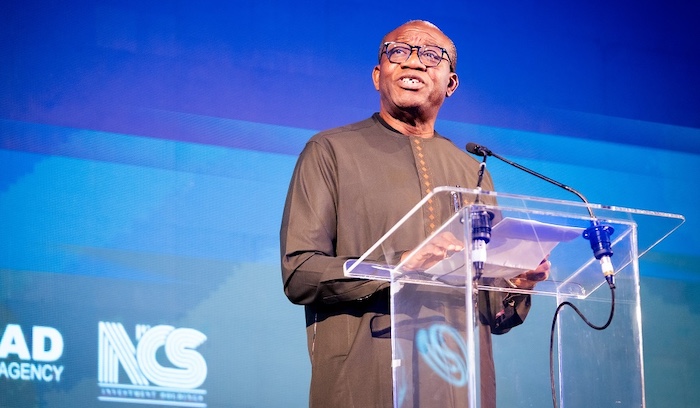
Former Ekiti State governor and founder of the Amandla Institute for Policy and Leadership Advancement, Kayode Fayemi, has called on African leaders to strengthen institutions, promote visionary leadership and deepen continental unity to secure Africa’s sovereignty and long-term development. Speaking at the 16th Thabo Mbeki Africa Day Lecture in Cape Town, Fayemi said Africa remains
Former Ekiti State governor and founder of the Amandla Institute for Policy and Leadership Advancement, Kayode Fayemi, has called on African leaders to strengthen institutions, promote visionary leadership and deepen continental unity to secure Africa’s sovereignty and long-term development.
Speaking at the 16th Thabo Mbeki Africa Day Lecture in Cape Town, Fayemi said Africa remains at a critical point where opportunities for growth coexist with insecurity, poverty, weak governance and institutional fragility.
According to him, true sovereignty in modern times goes beyond political independence and territorial control, stressing that nations must possess the capacity to manage resources effectively, strengthen economies, secure borders and provide opportunities for citizens.
Fayemi described Africa as a continent rich in resources, youthful energy and global relevance, but warned that poor leadership, weak institutions and economic dependence continue to undermine progress across many countries.
He stressed that Africa must avoid remaining only a supplier of raw materials in the global economy, especially as the continent becomes increasingly important to the world’s green energy transition because of its mineral resources.
The former Minister of Mines and Steel Development also advocated stronger regional integration through the African Continental Free Trade Area, saying Africa’s future prosperity depends on interconnected economies, shared infrastructure and coordinated policies rather than isolation.
On governance, Fayemi criticised the resurgence of military coups in parts of Africa, particularly within the Sahel region, insisting that constitutional democracy must remain the legitimate path to leadership. He, however, noted that military takeovers often reflect deeper governance failures and declining public trust in democratic systems.
According to him, Africa’s development cannot be sustained through personality-driven politics or slogans without strong institutions capable of ensuring continuity and accountability.
Fayemi further called for ethical leadership, urging African leaders to build enduring systems instead of focusing on temporary political power.
Addressing xenophobia and Afrophobia on the continent, he reminded Africans of the solidarity shown during the anti-apartheid struggle and warned that hostility against fellow Africans weakens the ideals of Pan-Africanism and continental integration.
He also highlighted the growing role of African youth in demanding accountable governance, transparency, economic opportunities and functional democratic institutions, referencing movements such as EndSARS as evidence of increasing political consciousness among young Africans.
On climate change, Fayemi argued that although Africa contributes the least to global carbon emissions, the continent suffers heavily from climate-related challenges, adding that Africa must industrialise while also demanding fairness and climate justice from the international community.
Concluding the lecture, Fayemi urged African leaders and citizens to embrace a renewed vision of Pan-Africanism anchored on solidarity, accountable governance and strong institutions, insisting that Africa’s future would ultimately depend on the choices made by the continent’s leaders and people today.















Leave a Comment
Your email address will not be published. Required fields are marked with *