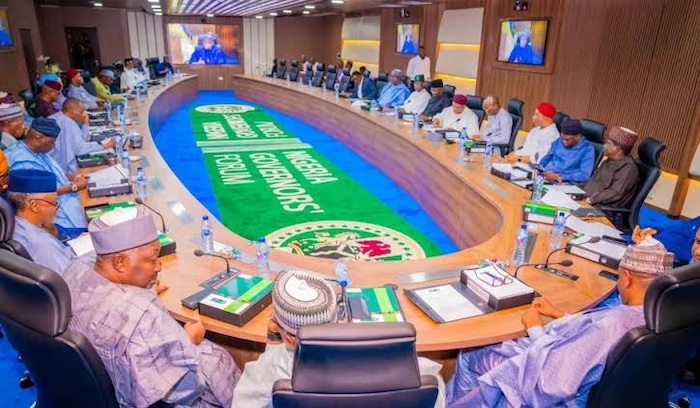
The Nigeria Governors’ Forum (NGF) has called on President Bola Tinubu to consider increasing the national minimum wage from N70,000 to N100,000 in response to rising inflation, escalating living costs and growing financial pressure on Nigerian workers. The appeal was made by the Chairman of the NGF and Governor of Kwara State, AbdulRahman AbdulRazaq, during
The Nigeria Governors’ Forum (NGF) has called on President Bola Tinubu to consider increasing the national minimum wage from N70,000 to N100,000 in response to rising inflation, escalating living costs and growing financial pressure on Nigerian workers.
The appeal was made by the Chairman of the NGF and Governor of Kwara State, AbdulRahman AbdulRazaq, during a meeting between President Tinubu and state governors at the President’s residence in Lagos on Friday night.
The gathering, which coincided with the Sallah celebration and the third anniversary of the Tinubu administration, provided an opportunity for discussions on economic reforms and workers’ welfare.
In a video posted on his Facebook page on Saturday, AbdulRazaq explained that the proposal for a new wage structure was informed by current economic realities and the need to improve the purchasing power of workers across the country.
The governor also commended President Tinubu for what he described as a courageous decision to remove the fuel subsidy, noting that only a small number of political leaders would have been willing to implement such a far-reaching policy.
According to AbdulRazaq, governors had anticipated widespread unrest following the announcement of the subsidy removal and consequently mobilised security agencies across the states while convening emergency security council meetings in preparation for possible protests.
He disclosed that substantial resources were committed to security arrangements because state governments expected significant public resistance.
“We were expecting serious riots, because there were riots — #EndBadGovernance riots — even before then and for lesser issues,” AbdulRazaq said.
He noted, however, that despite the preparations, no protests or riots occurred on the day the policy was implemented.
“Lo and behold, we spent money and mobilised the security agencies to secure the states. Lo and behold, on that day, nothing happened. There were no riots or protests anywhere.
“I think the nation was shocked by the audacity of Mr. President to implement that serious policy. Today, we’ve benefited immensely from that policy,” he added.
The governor stated that the financial position of many states had improved significantly since the subsidy removal, noting that state governments were no longer relying heavily on borrowing or bond issuances to pay salaries and execute projects.
Using Kwara State as an example, AbdulRazaq explained that prior to the reforms, little remained after salary payments from federal allocations.
“I can say as a matter of fact, in my own state, when we get the FAAC allocation, after paying salaries, we’re left with N100 or N200 million,” he said.
The NGF chairman stressed that state governments recognise the urgent need to improve workers’ welfare and are currently engaging the federal government and organised labour to develop a wage structure that balances employee welfare with fiscal sustainability.
According to him, consultations are ongoing to ensure that any adjustment to wages does not place an unbearable financial burden on state governments.
“We are actively engaging with the federal government and organised labour to arrive at a wage structure that is fair to workers and sustainable for government finances,” he stated.
He explained that discussions are focused on improving workers’ living standards while preserving the capacity of governments to continue funding infrastructure projects and delivering essential public services.
“The goal is to improve the living conditions of workers while ensuring that states can continue to meet their obligations and sustain development projects that directly impact citizens,” AbdulRazaq said.
He emphasised that while workers deserve better remuneration, policymakers must also take into account the fiscal realities confronting subnational governments.
The governor further revealed that many states are already paying a minimum wage of N100,000, exceeding the current statutory national minimum wage of N70,000.
“I am urging Your Excellency, let’s have a discussion on moving the minimum wage to a minimum of N100,000.
“We know we’ll get support from you as we go ahead to implement that,” he said.
In June 2024, President Tinubu approved an increase in the national minimum wage from N30,000 to N70,000 after signing the National Minimum Wage Bill into law. The legislation provides for a review of the wage every three years.
The previous minimum wage of N30,000 was approved in 2019 under the administration of former President Muhammadu Buhari.









Leave a Comment
Your email address will not be published. Required fields are marked with *