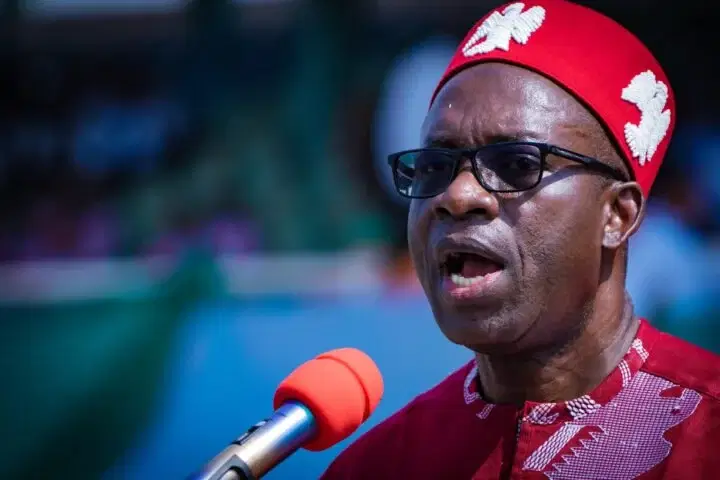
Anambra State Governor, Chukwuma Soludo, says the national conversation on state police has moved beyond debating its necessity, stressing that attention should now be on developing an effective implementation framework while pursuing wider constitutional reforms to strengthen Nigeria’s federal security and justice system. Speaking virtually at the ARISE News Town Hall on State Police, Soludo
Anambra State Governor, Chukwuma Soludo, says the national conversation on state police has moved beyond debating its necessity, stressing that attention should now be on developing an effective implementation framework while pursuing wider constitutional reforms to strengthen Nigeria’s federal security and justice system.
Speaking virtually at the ARISE News Town Hall on State Police, Soludo described state policing as one component of a broader effort to build a more functional federal system. He argued that reforms to revenue allocation and the judiciary must accompany the establishment of state police.
Apologising for his inability to attend the event in person due to scheduling conflicts, Soludo commended ARISE News for convening the discussion and praised earlier presentations by Senator Adams Oshiomhole and the Governor of Enugu State.
He also lauded the National Assembly for advancing the constitutional amendment on state police and commended President Bola Tinubu, whom he described as a “Professor of Federalism,” for championing reforms aimed at strengthening Nigeria’s federal structure.
According to Soludo, the debate over whether Nigeria should have state police has effectively been settled.
“The issue is no longer whether or not to have state police. The issue now is how.”
Drawing from Anambra’s security experience, the governor said the state’s successes—including reclaiming eight local government areas previously under siege, dismantling 62 criminal camps, and ending sit-at-home disruptions—were achieved through close collaboration among federal, state and private security agencies.
He disclosed that committees involving the National Security Adviser, the Attorney General of the Federation, the Chief of Staff to the President and state governors are already working on implementation details, including the type of weapons state police officers should carry. He argued that officers should not be expected to confront heavily armed criminals with inferior weapons.
Soludo, however, cautioned against treating state police as an isolated reform. He said it must be part of a broader restructuring of Nigeria’s security and governance architecture.
While acknowledging recent constitutional reforms such as electricity market devolution, local government autonomy and progress toward state policing, he argued that significant reforms remain unfinished.
He criticised the current revenue-sharing formula, noting that responsibilities are increasingly being devolved to states without corresponding fiscal adjustments. According to him, the federal government currently retains about 53 percent of federation revenue while states receive roughly 26 percent. He proposed that the federal government’s share should not exceed 40 percent, with more resources allocated to the states.
Soludo also called for reforms to Nigeria’s judicial system, describing it as largely unitary despite the country’s federal structure.
He questioned why purely state matters, such as land disputes, can progress through the entire federal appellate system to the Supreme Court, noting that such cases can take 30 to 40 years before reaching final judgment.
Using Anambra as an example, he said land disputes account for nearly 70 percent of litigation and contribute significantly to violence because of the state’s limited landmass. He argued that such matters should end within state judicial institutions.
Referencing the United States, Soludo noted that every state operates its own Supreme Court and suggested Nigeria should adopt a similar model by establishing state supreme courts and appellate systems to speed up justice delivery.
He added that as states establish their own correctional centres, it makes little sense for appeals in purely state matters to remain tied up in federal courts for decades.
The governor concluded by urging policymakers to use the state police conversation as an opportunity to complete Nigeria’s transition to a truly federal system through reforms that include state policing, fiscal restructuring and judicial devolution. He also called on the National Assembly and President Tinubu to sustain efforts toward advancing true federalism.


















Leave a Comment
Your email address will not be published. Required fields are marked with *